SaaS case studies: improve SEO ranking and increase revenue

Case studies are like word of mouth—they make it easier for you to build social proof and show your potential clients that your product works. In a world where most customers are looking for products that offer real value, case studies will always come in handy. Case studies are like trailers/advertisements that show how things will turn out for potential customers once they take a certain action.
Here’s a breakdown of everything that goes into a case study.
1. Results and how your product helped companies move from point A to point B
There’s nothing more exciting than seeing proof of what you are aiming for, especially if it’s broken down to the nitty-gritty bits. First, it motivates potential customers by showing them their goals can be easily achieved.
Always aim to provide results in an easy and friendly way—explain how your product helped a company/individual move from point A to B. For instance, you might mention the revenue increase after a certain period of time to show your potential customers what is possible.
Here’s a good example of that:
Before we started working with this media company, they were doing $5,000,000 in revenue, but they wanted to take it to the next level by streamlining customer onboarding, so they could bring in more customers.
After using our platform to automate client onboarding and customer support, they had more time to bring in more customers, so the revenue increased from $5,000,000 to $7,000,000 in three months.
It’s always advisable to highlight different metrics before an organization starts using your services. Numbers and percentages indicating change will be your best friend while implementing this.
Showing the effort that went into a certain task paints a clear picture of how your SaaS platform can achieve a certain goal.
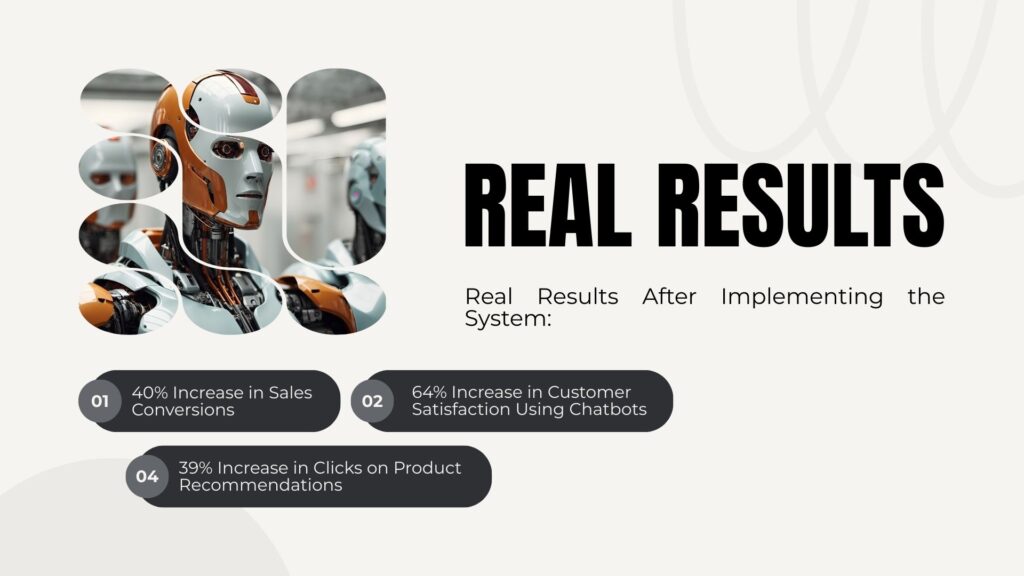
In case studies, numbers and percentages should be the loudest on a page. Look for something that will make numbers stand out — bold colors, large fonts, and bold fonts. Potential customers should notice your metrics from the moon or Mars 😉
Remember: each metric is related to a certain challenge an organization is facing and trying to solve.
2. Products and features that aided in the journey
While potential customers will be quite eager to dive deeper into metrics, they would also love a beautiful breakdown of the features you are offering on your SaaS platform.
This makes it easier for them to link a certain result to a feature on your platform. For instance, in the example we provided, the SaaS platform streamlined customer onboarding.
The next step after outlining the metric is to mention the customer onboarding feature and break it down at a deeper level.
The trick here is to dig deeper into the feature, using a friendly tone — go for something that can be easily understood by everyone. Provide more details on how the task was cumbersome before a certain feature streamlined the operations.
Use bullet points to show the pros of automation and the cons of manual workflows. This is quite effective in showing the contrast in workflows and automations.
Also, link such features to informative posts published on your website. Apart from redirecting potential customers to how-to posts that are quite informative, internal backlinks will also boost your site’s overall SEO.
Backlinks are quite effective in creating a structure of posts, making it easier for potential customers to learn multiple topics.
(reach out if you want to implement such strategies)
3. Initiative companies can take to move from one point to the next
Provide a course of action for companies that want similar results. You can ask them to create an account on your platform after outlining each plan. If you have different plans, break down the features and provide a guideline for each company size.
For example, the free plan would be suitable for your company/organization if:
- Reason 1
- Reason 2
- Reason 3
The entry plan would be ideal for your company if:
- Reason 1
- Reason 2
- Reason 3
The middle-tier package is best for:
- Reason 1
- Reason 2
- Reason 3
For companies that want to try out your services without committing, the best onboarding strategy would be a free trial that lets them dip their toes into your SaaS services. Provide a timeline for trying out the services and upsell the premium plan when the freemium plan delivers the results.
Have a call to action (CTA) at the end of the case study that motivates potential customers to take a certain action.
Over To You
Case studies are the deal when it comes to showcasing results. Always highlight metrics with huge font sizes, headers, and bold formatting.
Remember, potential customers want to check whether your organization is capable of achieving certain goals. By going through case studies, they’ll know you are walking the talk. Such content is also quite effective in building social proof and creating a certain authority in a niche. And this boosts your SEO visibility. Once Google establishes you as the authority, your ranking improves.